A call for collective action, planetary citizenship, and infrastructural poetry to transform our world.
And the spreadsheet said: "These are your borders."
And the spreadsheet said: "This is your debt."
And the spreadsheet said: "You may remodel your bathroom. You may not coordinate a humanitarian relocation project unless you've cleared Level 49 of Bureaucratic Compliance."
Pause. Rewind. Ask yourself
Why is it that across the Earth's crust, people with the same jawlines, the same displaced great-grandmothers, the same childhood fascinations with construction trucks and futuristic cities — find themselves on opposite sides of a chasm dug by fake authority?
Why is it that the raw human brilliance of one camp is hoarded into defense contracting spreadsheets, while the other is told to be proud of their "historical resilience" — a euphemism for "stay put and suffer quietly"?
Why are the minds who could design energy grids, water systems, alternative governance hubs — being funneled instead into TikTok DIY remodels and off-grid cabin dream fantasies, while entire populations are treated as rotting liabilities?
The paradox is this: Never before has humanity had so much distributed talent, yet so little collective agency.
Because power isn't being used to solve the crisis.
It's being used to perpetuate it.
Dominator cultures obsessed with maintaining control by default.
Regimes still hallucinating about empire, ethnic origins, or whatever antique nonsense justified trauma in 1937.
Burning itself out in loops of outrage, mourning and performance.
Meanwhile, the bombs drop.
Meanwhile, the cold apartments.
Meanwhile, the classrooms where hope has been removed from the curriculum.
Meanwhile, the teens taught how to field strip rifles before they learn how to read blueprints.
And who is responsible for this?
That is the question no one wants to answer. Because answering it means admitting something:
We must reimagine agency — from the ground up.
Moving beyond the limitations of traditional aid models
Rejecting the notion of heroic intervention
Building systems that enable true agency
Creating rational frameworks for collective action
The 20th century rules no longer apply. If you think the solution to to the war-torn corners of the world, is to "let their governments decide" — you are living in a vintage Cold War museum exhibit.

That logic expired before broadband was installed.
The people who are being bombed, manipulated, ignored, displaced — are not just casualties.
People with the capacity to construct new realities when given the opportunity
Partners in creating solutions rather than recipients of aid
Individuals with unique perspectives that can reshape our approach
They are untapped assets in the highest form of the word. Not in theory — in reality. If you give them the space, the safety, the tools.
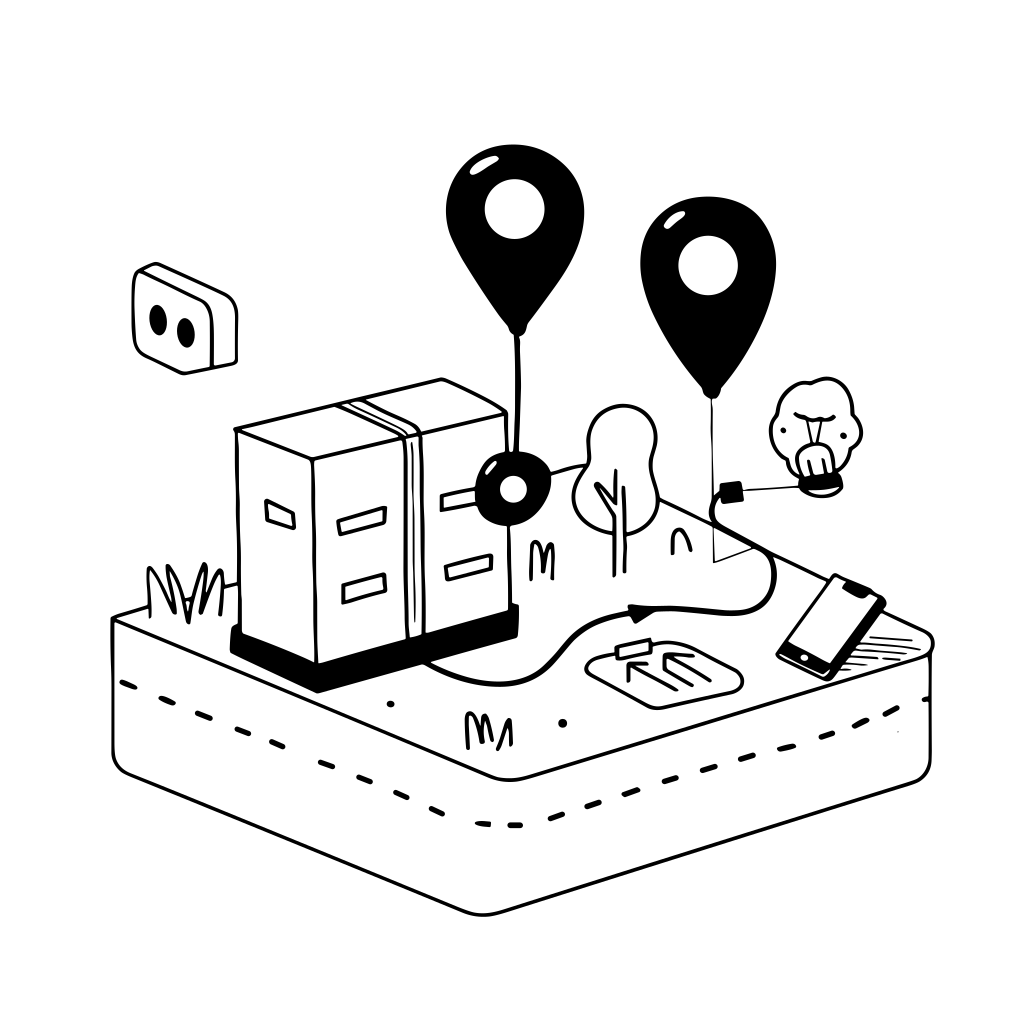
What's needed now is an International Zone of Constructive Return — a neutral, post-national territory where all that wasted potential can go to work.
Chihuahua. Sonora. Baja.
Turn those forgotten corners into the next Dubai — not through oil money and glass towers, but through collective agency, planetary citizenship and infrastructural poetry.
Send American engineers. Scandinavian architects, Bulgarian software leads. Palestinian agritech pioneers.
Let it become a global commons of rebirth — where bombs are replaced with training drills and refugee camps give way to solar-tiled homes and open source logistics hubs.
Let it be the place where the question "Who's responsible?" finally has an answer:
We are.
Because it's already ours to fix.
And because every spreadsheet in the world — no matter how redlined or formula-locked — can be overwritten by a better system. A human one. A legendary one.
You can't stop war with outrage.
You stop it with solar roofs.
aka The Sofa Sovereigns and the Smoke of Excuses
The excuses for NO, rather than Why Not often begin the same way.
Propose something real — something that requires shifting weight, moving bodies, rearranging old privileges into new responsibilities — and watch the room fill with invisible farts of indifference.
The comfortably numb reply from the soft-bodied kings of stagnation is always some flavor of:
"Oh, that's too complicated."
"Oh, that's not my job."
"Oh, those people wouldn't fit in anyway."
Their breath stinks of old smoke. Their vocabulary is a mismatched set of borrowed opinions from cable news and reactionary Reddit threads. These are the Sofa Sovereigns — emperors of no realm, protectors of no truth. Just people clinging to whatever crusty cushion lets them keep ignoring that the world is on fire.
And yet they are legion.
Content to remain passive observers rather than active participants
Unwilling to coordinate meaningful action or create structure
Absent when it comes to the actual work of reconstruction
With mockery, deflection, and spiteful one-liners that sound like moral positions but are really just fear in drag
Try to suggest, for example, that thousands — even millions — of people could be constructively relocated from shattered geographies and zones of ruin…
Not to refugee limbo.
Not to oil pipeline outposts.
But to actual, planned zones of regeneration.
You'll hear the couch philosophers puff out:
They disguise their inertia with concern.
They mask their racism with realism.
They frame their emotional laziness as "logical critique."
Here's the reality check:

The Persian Gulf already did it.
In one of the boldest, most unspoken acts of demographic engineering in modern history, the Gulf States invited — voluntarily and with massive structural intention — millions of non-ethnic Indians, Pakistanis, Filipinos, and more to populate and operate their entire economies.
A pragmatic approach to development
Beyond superficial image management
Despite ethical shortcomings
They did it because it worked.
It made economic sense.
It created cities out of sand.
It proved, in undeniable terms, that people can move across imaginary lines and build entirely new ecosystems together — regardless of ethnicity, origin, or artificial national assignments.
So next time someone groans from their nicotine-padded perch and says:
"You can't just take people from one place and put them in another like that."
You answer:
"You mean like the Gulf did? Successfully? At scale? For decades?"
This isn't theory. This is historical precedent.
The myth that people are too fragile to move, too tribal to cooperate, too culturally incompatible to build — is just that. A myth. A bedtime story told to those who'd rather keep their living rooms smelling like resignation.
The 21st century demands a higher calling of logistics, not another rerun of "who belongs where."
We already proved that mass migration for opportunity works.
We already saw it produce booming skylines, economies, and yes — hybrid cultures that surpassed what came before.
So what's stopping it now?
Only the stink of old minds.
Only the lies told by comfort.
To reimagine agency means to call that out.
It means recognizing that the people who resist bold proposals the hardest are rarely those in the field, in the rubble, in the actual chaos.
They're usually the ones sipping cold coffee in lukewarm houses, scrolling past headlines and convincing themselves they're "too informed" to believe in change.
We build.
We move.
We reimagine agency.
aka The End of Sobbing Solutions
We are not interested in more crying banners.
We are not inspired by close-up shots of dirt-streaked cheeks under soft UNICEF lighting.
We do not believe that yet another "Donate Now" overlay slapped across a trembling child's face is going to fix a single damn thing.
Let's be brutally clear: that pitiful model is dead.
Sad performance
Sedative
A drug for the mildly privileged to inject just enough emotional guilt to feel they've contributed — and to secure a tax write-off in the process.
While the root systems of violence, displacement and infrastructural abandonment remain untouched.
It's not just ineffective. It's insulting.
You cannot weep the world into order.
You cannot patch over systemic collapse with emotionally manipulative war zone footage and surplus donate trinket sales.
Organized, strategic planning across borders
Moving people to places where they can thrive
Not of demagogy. Human beings that require solutions
Because the truth no one wants to say out loud is that sending remittances into a war zone is like throwing spare change into a volcano.
No more anonymized wire transfers to affected regions.
Move the people.
You don't need every displaced person to be a "qualified professional" by the laughable standards of bureaucrats who still haven't figured out how to organize their own email inboxes.
These are humans. Humans adapt.
They can learn, on site, while doing — especially when given tools, mentorship and a reason to build.
The West is bursting with dormant brilliance.
People who have energy that doesn't sleep.
And what are they told to do?
Clean someone's garage.
Organize junk drawers.
Fix a corner of drywall.
Help someone "finally declutter."
This is societal miswiring of the highest order.
When high-octane minds are trapped in basement cleanup rituals, instead of designing sovereign energy modules or overseeing refugee-to-citizen training programs, you know the system has failed.
Should be city architects
Should be field logistics leads
Should be drafting international protocols for progressive relocation hubs
We are calling for the creation of a civilian peace corps with military-grade logistics — not to invade, not to enforce
To coordinate relocation and rebuild.
Properly. Calmly. Efficiently.
Get vetted displaced people on buses.
Put them on planes.
Deliver them to designated zones of construction, not squalor.
Give them tools. Let them learn.
Surround them with forward thinkers, builders, medics, organizers, coders, translators and solar panel specialists.
No more sobbing.
No more sentimental distractions.
No more pretending that sporadic emotion or donation funnels are anything other than bandages on bullet wounds.
Create rhythm. Momentum. Fraternity. Civilizational momentum.
We need plans. We need programs. We need people.
Above all: we need to stop crying for the world and start building it with those who were cast aside by the world's dysfunction.
It's not about charity.
It's about capacity.
It's not about feelings.
It's about formation.
Because this time, the world isn't saved by the donors.
It's saved by the organizers.
Reimagine Agency